MARIE: Once upon a time, I was very bad at asking for help. I used to get all embarrassed - I guess I felt that I was somehow inadequate if I couldn't manage everything on my own, and I felt it was an unreasonable imposition on friends and family to ask them to step in where I failed. I had no problem with offering help or being asked for it, though. Not very logical.
As Jon has got worse, I have had to learn to ask for help. In a somewhat roundabout manner, I had been urging other carers to ask for help, but took a while to realise that I might do well to take my own advice. Lots of people want to help, but may not know how to. And if we (I) don't tell them what we need, how can they know how to help us? The first time I asked for serious help, I had to really pull myself together, but it's getting much easier - and it helps that I am still waiting for that first rejection.
We get some assistance from the local council, of course, like the night nurses and the transport service to Jon's day centre, but I don't really count that as help, more as necessary support that we've been saving up for through years of tax paying.
Personal help is different. I believe in "paying it forward" and have tried in my own small ways to practice that. Now that we're firmly on the receiving end, I'm realizing the true value of friendship and helpfulness.
We get lots of practical help. My parents garden for us, my nephews fetch and carry, a neighbour keeps an eye on things whenever I'm away, my cousin's coming round to chop wood, my sister has helped with medical advice and supplies, etc. etc. etc. I count us very lucky to have such generous people around us. But there are two forms of help that go way beyond normal generosity.
The first is Jon's best and oldest friend, who has quite simply moved in with us to help me care for Jon until we are offered a nursing home place. He has been with us for a month and a half now and is showing no signs of being fed up yet. His presence and his practical help (which extends beyond care to lawn mowing and home repairs) makes an enormous difference to our quality of life.
The other is Jon's first wife, who again last week vacated her flat to let us stay there while visiting Jon's daughter and her family. No. 1 wife then takes over the tiny guest room in Jon's daughter's house, which has just proven impossible for us to fit into. Yes, we could go to a hotel instead, but a visit is many times more enjoyable when we can stay in a flat with separate bedrooms and space for Jon to walk off his restlessness in the night.
Aren't people like that just amazing?
Showing posts with label holiday. Show all posts
Showing posts with label holiday. Show all posts
17 July 2014


22 October 2013
Micro planning
MARIE: I’m away, and it’s great. Away as in on
holiday, all on my ownsome, with no responsibility for anyone or anything. Just
me and the cats and a pile of books and some gorgeous walks right outside my
door for a whole, brilliant week. I picked this place based largely on a user
evaluation that declared it a beautiful area and a well-appointed holiday flat,
only too bad that the area was kind of boring with no people. YES, I thought,
that’s precisely what I want and need.
An important bonus is that while I am off
communing with nature and literature, Jon is well cared for and feeling quite
content. It took some doing, though. I will admit to being a bit of a control
freak, but preparations for this trip really tested my skills at micro planning
and micro management.
Our care liaison at the local authority came round for
a long meeting to determine Jon’s needs and to what extent they would be able
to meet them. Quite a large extent, I am happy to say. He gets visits at 6
am to fit the duodopa pump, at 8 am to help with showering and dressing and
breakfast, at 4 pm as a general check-up (which probably isn’t necessary), at
6 pm to serve dinner, and at 10 pm to disconnect the pump.
We had a steady stream of nurses and nursing
assistants through the door the last few weeks before I left so that they
could all learn how to work the pump, where things are kept, and what must
under no circumstances be forgotten. I left them with prepacked drug doses, an
appropriate number of home-cooked ready meals in the freezer, and numerous lists of phone
numbers and appointments and key points and whatnot – some because I felt it
was necessary, others because they asked me.
In the middle of all these preparations, it became
clear that I was failing to teach Jon how to look after the cats, so
further arrangements had to be made for people to come in and care for them during the first few days of my break, until I could
make it back to collect the kitties.
By the time I finally got here, I so needed a break.
We parted on less than happy terms, I’m sorry
to say. I needed to do a quick supermarket run before stuffing the cats in
the car and setting off, so offered Jon a lift if he too wanted to
get some groceries. He accepted, but turned out to want the electronics
store rather than the supermarket. In fact, he thought I could just drop him
there and he’d take the bus home. Now, 9 times out of 10, that would work fine,
but what if this was that dreaded tenth time? What if I got a call half-way across the country
to tell me that Jon had fallen down in the street, or got on the wrong
bus, or lost his way, or gone OFF and been unable to move – all
things that have happened in the past. So I wouldn’t let him take the bus. That
pissed him off. So I took him to the electronics store and waited while he did
his shopping. That pissed me off. And when it came time for me to leave, he was
still too pissed off to say a single pleasant thing to me, even though I begged
him repeatedly. Oh well, at least one of us soon forgot that. I really need to
stop minding so much and just accept that he can’t help it.
I’ve talked to Jon
several times since I left and have been relieved to hear that he is well and that the week
has brought few challenges. He’d be happy to do this again, and so would I. I
hope the nurses agree.
24 February 2013
Carpe diem
MARIE: As we’ve said, with the duodopa pump comes
better symptom control, and with that comes a greater freedom and eagerness to
participate in life. And boy, do we participate. Although Jon’s PD is better
controlled now and he has almost gotten rid of the debilitating OFF states,
Parkinson’s continues to nag at us to make the most of now, because you never
know what’s round the corner. Could be more good, but could equally well be
another downwards slide, new symptoms, drug intolerance, whatever. So we are
seizing the day and carping the diem.
After that comes a short visit from another foreign friend, a two-week period of staggered visits from the family to celebrate Jon’s big birthday, and then we’re off to a pump users’ meeting in a different part of the country so will take the opportunity to make a small holiday of it. Then my parents come down for the soon-to-be traditional month of hard gardening labour, we must organize a visit from our good Dutch friends, we’ve got another two domestic holidays booked and are planning another UK trip, there’ll be an invasion of nephews at some point, and also my equally big birthday later in the summer, and…and…and…
On Jon’s part the
issue is more straightforward. Yes, he has gotten rid of the horrible OFFs, but
he still has unpleasant dips in his general state. These he can counteract by
taking an extra dose (using what we call the ‘happy button’ on the pump), but
the ideal time to take it is just before he needs it. That means he’ll have to
learn to predict which activities will deplete his dopamine levels so he can
act early and avoid even the smaller dips. He had quite a bad dip last week
when he went out bowling with the Oak House guys. The fun of it carried him
through until he had run utterly out of dopa, and it took him quite a while to
get back in the saddle. But he’ll learn, we’ll learn, and meantime life is
still a whole lot better than it was.
First, of course, was the trip to the UK that I told
you about in the last post. Then last week we had a visit from two UK friends
with Parkinson’s – enormously enjoyable for Jon as he turned the best room in
the house into a huge electronics workshop for the duration. Also much talking,
walking and eating. Sightseeing not so much, as it’s no mean feat to get three
Parkies to feel up to an excursion at the same time. On the other hand, that
was perhaps also the joy of it: that there was no need to pretend or to push
oneself as everyone except me was in the same boat.
Next week we get a long visit from Jon’s oldest friend,
and I shall take the opportunity to nip out for a few days. I’ve asked for the
home nurse to come and help with pump matters morning and evening, but in
between the two of them will be on their own. I think they can do it, and that
Jon is eager for the independence of a few days without my constant presence.
We’ll let you know how that goes.
After that comes a short visit from another foreign friend, a two-week period of staggered visits from the family to celebrate Jon’s big birthday, and then we’re off to a pump users’ meeting in a different part of the country so will take the opportunity to make a small holiday of it. Then my parents come down for the soon-to-be traditional month of hard gardening labour, we must organize a visit from our good Dutch friends, we’ve got another two domestic holidays booked and are planning another UK trip, there’ll be an invasion of nephews at some point, and also my equally big birthday later in the summer, and…and…and…
Looking at our schedule, I am torn between despairing
at the amount of stuff we have planned – how on earth am I going to find the
time to write the next book? – and on the other hand thinking that this is exactly
the reason why I don’t go out to work: so Jon and I can squeeze every last drop
of good out of life while there’s time. I may not go out to work, but I still
struggle to find the right work-life balance.
07 February 2013
Travels with the pump
MARIE: We’ve
just had a long weekend in the UK – partly to see Jon’s daughter’s new house
(and family and friends, of course), and partly to test out traveling with the
duodopa pump. We were both mildly apprehensive. Would we be believed by airport
security when we told them that Jon now has a tiny metal part inside him and
can no longer go through the scanner? Would they accept that we carried all Jon’s
gel form medication in hand luggage? No way would we ever let drugs go in the
suitcase, a delay or misdirection of luggage with drugs doesn’t bear thinking
about. Would the drugs stay cool in their special thermal bag for the duration
of the journey? And would the hotel be able to keep the drugs cool for us, yet
allow easy access to fresh drugs in the morning?
I am so happy and relieved to say that the answer to every one of the questions was a clear YES. Apart from having to carry the thermal bag around – which would be quiet heavy for a long trip – travels with the pump are significantly easier than travels with pills. Going across time zones? No problem. We used to try and stretch or compress drug timings on travel days to fit both with time zones, long days, and urgent bursts of activity. Now, the meds are just constantly flowing, there’s no need to plan or discuss anything, Jon just presses the lovely extra-dose button, and off we go. Put the pump on in the morning, take it off at night, and don’t worry about a thing in between. Oh, the relief. It’s wonderful to know that we’ll be able to travel by air again without any anxiety.
Two more things helped make the trip a success. It was clear on our last trip to the UK that the whole business of travel and any lack of home comforts at the destination really wears Jon out, to the point where he hasn’t the energy to enjoy the purpose of the trip. So this time we broke it up. We flew over, but instead of getting the airport train and then waiting for a ride and then having a social situation, we simply checked into the airport hotel and stayed the first night there. We’ll definitely do that again, it’s now vastly better to have two unstressful travel days rather than one demanding one.
I am so happy and relieved to say that the answer to every one of the questions was a clear YES. Apart from having to carry the thermal bag around – which would be quiet heavy for a long trip – travels with the pump are significantly easier than travels with pills. Going across time zones? No problem. We used to try and stretch or compress drug timings on travel days to fit both with time zones, long days, and urgent bursts of activity. Now, the meds are just constantly flowing, there’s no need to plan or discuss anything, Jon just presses the lovely extra-dose button, and off we go. Put the pump on in the morning, take it off at night, and don’t worry about a thing in between. Oh, the relief. It’s wonderful to know that we’ll be able to travel by air again without any anxiety.
Two more things helped make the trip a success. It was clear on our last trip to the UK that the whole business of travel and any lack of home comforts at the destination really wears Jon out, to the point where he hasn’t the energy to enjoy the purpose of the trip. So this time we broke it up. We flew over, but instead of getting the airport train and then waiting for a ride and then having a social situation, we simply checked into the airport hotel and stayed the first night there. We’ll definitely do that again, it’s now vastly better to have two unstressful travel days rather than one demanding one.
And the other
thing that helped was that we swallowed all pride and asked the family for help
with lifts and a really comfortable place to sleep. I have regularly suggested
to other carers that they should ask for help from their families instead of
waiting for people to guess at how they can help, but I’ve not been good at
taking my own advice. I was really quite overwhelmed at the generous help and
consideration we got on this trip, the trouble they were prepared to go to in
order to give Jon the best basis for having a good time. Which he most
certainly did, as did I. We’ll be back, as he’s taken to saying.
By the way, it
was funny to note how un-embarrassed we have both become. This was the first
time the family had a chance to see the pump and Jon’s extra orifice, so he
prepared to do a little show-and-tell. I’m not sure if it was discretion or a
slight squeamishness on the part of his audience, but that didn’t take long at
all. I guess by now Jon and I are so used to the evidence and paraphernalia of
disease that we don’t think of it as anything out of the ordinary. Maybe we
need a little reality check.
12 November 2012
Goodbye Piccadilly, Farewell Leicester Square
 MARIE: We went to London last weekend. Jon’s been itching to go to see an exhibition about the computing pioneer (and WWII code breaker) Alan Türing. After the war Türing worked at the same university department as Jon’s dad – Türing was very much the theoretician, while Jon’s dad put theory into practice by writing the very first chess software. Consequently, Jon’s dad got a display case all to himself at the exhibition, which was well worth seeing. (Jon also believes to have briefly sat on Türing’s knee as a toddler, a gratifyingly eccentric claim to reflected fame.)
Anyway, encouraged by the success of our Amsterdam trip (see blog posts past), we set off for London. The old question of whether it is better to travel than to arrive has been decisively answered by the budget airlines. After a long day involving 5 modes of transport with much walking and lugging of luggage in between, we finally arrived Friday night at a hotel near where we used to live in East London.
Saturday morning we slept in, then ambled down the high street breathing the familiar big city fumes. Jon found it more difficult than ever before to deal with the pedestrian dance of sto
p – go – lurch sharply to avoid umbrella – go – run for green light – stop for pram. He was festinating away quite alarmingly, tripping himself up, feeling his feet stuck to the ground at the wrong time. If you don’t know what festination looks like, it’s as if the upper body moves forward as intended while the feet stay behind, and then when a fall is imminent, the feet suddenly come ‘unstuck’ from the ground and rush in many tiny steps to catch up with the body. A bit of a concern around the house, and bloody terrifying in the middle of London traffic.Happily, though, Jon survived long enough to be reunited with his daughter, son-in-law and two lovely grandchildren. We had a long leisurely lunch, then Jon had a little nap while the rest of us played outside, then another meal together, and finally a drink in the hotel bar. A long day, but an intensely enjoyable one.
Sunday was the family excursion to see the exhibition. The Science Museum is right next door to the Natural History Museum, home to dinosaur fossils and stuffed whales, and so of enormous interest to the grandchildren. In we went – Jon’s walking stick and the look on his face got us whisked past the long queue – to a museum where the collection is as spectacular as the building is noisy. Hard surfaces and high ceilings plus thousands of over-excited children was a bit much for Jon, so he and I retired to the café with grandson, where we spent a pleasant half-hour drawing imaginary butterflies and setting them loose to flutter around people’s heads. Then on to the Türing exhibition, which was small and perfectly formed. Granddaughter and I made it a particular point to talk loudly throughout about how famous her great-granddad was.
Then, and this is where we perhaps pushed the boat out a bit far, we were joined by the in-laws who had traveled for hours to enjoy a late lunch with us before getting straight back on the train. Each individual element of the day was perfectly fine, but two exhibitions and a sociable meal out on the same day is just one event too many for Jon. At the end of the meal, we said our goodbyes in the restaurant because I could see that he was just too exhausted to come along and wave everyone off at the station.
And that was basically that. We had another two days in London, but although we spent some more time walking around the old neighbourhood, we never ventured into the centre again, and spent most of our time either in the hotel room or in the blissfully music-free pub across the street. There was just no energy whatsoever left in Jon. It was the combination of the stresses of air travel (by contrast, we drove to Amsterdam), too many activities in too short a time, and (especially, in my view) the relentless sensory onslaught of such a large and busy place.
I have a theory that if you never try something and fail at it, it’s because you’re being too timid. You have to stretch yourself, test your limits, and sometimes you end up over-stretching. We used to love London when we lived there 15 or so years ago, but now we have to accept that London is simply beyond us. Parkinson’s is turning us into small-town folk and nature lovers.
24 July 2012
It’s social life, Jim, but not as we know it
MARIE: We’re at the start of a busy summer of visits from family and friends, mostly ‘Jon’s people’ a few at a time for longer stretches and ‘my people’ in brief hordes. Looking at the calendar, there’ll never be more than 6 days between visits from now and until at least early October. This is a cause for much joy and celebration (and overeating), because it’s wonderful that these lovely people want to spend time with us in our rural exile-idyll.
But with Parkinson’s in the house with us, it’s not as easy as it used to be. Jon is slow to get started in the mornings and I need to be on hand to help, even if the help turns out not to be necessary some days. Jon also needs regular breaks, when we’re out and about he needs to sit and rest every so often, and when we’re home he zones out in his comfy chair or goes for a little lie-down. Late nights are a thing of the past, especially if he’s to be functional the next day. But within those constraints he does hugely enjoy these visits from home.

Last week’s visit from Jon’s son and daughter-in-law was the first visit of the summer and (weather aside) it couldn’t have gone better. Not only was I relieved of cooking half the time, they also helped us shift furniture, fix computers, burn garden rubbish etc. etc. On top of which we made some interesting excursions, including a day out at a large hole in the ground that Jon’s been wanting to see for ages. I hope the kids enjoyed it as much as we did.
But with Parkinson’s in the house with us, it’s not as easy as it used to be. Jon is slow to get started in the mornings and I need to be on hand to help, even if the help turns out not to be necessary some days. Jon also needs regular breaks, when we’re out and about he needs to sit and rest every so often, and when we’re home he zones out in his comfy chair or goes for a little lie-down. Late nights are a thing of the past, especially if he’s to be functional the next day. But within those constraints he does hugely enjoy these visits from home.
For my part, I feel the absence of an active co-host. We’ve chosen our families wisely and each and every one of them is helpful and thoughtful, nevertheless I almost invariably find myself first to rise and last to bed. Plus there’s the planning and shopping ahead of visits and the cleaning and laundry after. That said, I too love the visits and wouldn’t miss them for the world.

A compromise has to be struck between the demands of Parkinson’s and our guests. This is an evolving negotiation with no permanent solution possible as the disease develops, but for now the ground rules are that guests must stay in the delightful dungeon we have kitted out for them until 10 am, must sort themselves out for breakfast, and must not expect anything to happen in a hurry. Plus the more help we get with the cooking and washing up, the happier I am.
14 October 2011
Ambulophobia
MARIE: We’re just back from our holiday, and what a fine trip it was too. There is a great deal we both deplore about the US (spectacularly undemocratic practices, the celebration of greed, creationist religious nonsense– just to mention a few little things) but we’ve got to admit it’s the perfect place for a holiday if you’ve got Parkinson’s.
We traveled from Copenhagen via Amsterdam to Atlanta. At no point before we arrived on US soil did any airport employee give Jon even the tiniest bit of leeway because of his condition, but in Atlanta he was treated like royalty and whisked past queues for special assistance treatment everywhere. This focus on making life easier for anyone brandishing a walking stick continues in a good supply of disabled parking spaces everywhere and in large disabled toilets in even the most dismal fast food outlet. Plus we just love American hotel rooms where it is perfectly normal to get two double beds so we can both have a good night’s sleep.
Tourist attractions are also highly geared towards anyone suffering, as most Americans outside a few cities in the northeast do, from ambulophobia (fear of walking). Parking is provided near all sights worth seeing, walking distances and number of stairs are meticulously listed, shuttle buses are provided as an alternative to even quite short strolls, and the patience of both guides and fellow tourists for slow walkers is admirable. In the larger supermarkets they even offer to lend you a motorized wheelchair!
 So we saw stuff and did stuff and enjoyed stuff. Not quite as much stuff as last time we were on holiday, though, and our planned itinerary did have to be adjusted quite early on as it became clear that Jon really can’t do more than one thing a day. So we learned to take things more slowly. Occasionally he napped in the car while I took in a museum or went for a walk in the woods or a dip in the ocean, and invariably he napped while I drove us from A to B. It worked out pretty well.
(If you zoom in really close, you might be able to see the giant fish Jon caught in the Atlantic. Him and Hemingway are as one.)
BTW, Jon had his neuropsychological exam yesterday. We need a day or two to think and digest it before posting about it. Next week.
We traveled from Copenhagen via Amsterdam to Atlanta. At no point before we arrived on US soil did any airport employee give Jon even the tiniest bit of leeway because of his condition, but in Atlanta he was treated like royalty and whisked past queues for special assistance treatment everywhere. This focus on making life easier for anyone brandishing a walking stick continues in a good supply of disabled parking spaces everywhere and in large disabled toilets in even the most dismal fast food outlet. Plus we just love American hotel rooms where it is perfectly normal to get two double beds so we can both have a good night’s sleep.
Tourist attractions are also highly geared towards anyone suffering, as most Americans outside a few cities in the northeast do, from ambulophobia (fear of walking). Parking is provided near all sights worth seeing, walking distances and number of stairs are meticulously listed, shuttle buses are provided as an alternative to even quite short strolls, and the patience of both guides and fellow tourists for slow walkers is admirable. In the larger supermarkets they even offer to lend you a motorized wheelchair!
 So we saw stuff and did stuff and enjoyed stuff. Not quite as much stuff as last time we were on holiday, though, and our planned itinerary did have to be adjusted quite early on as it became clear that Jon really can’t do more than one thing a day. So we learned to take things more slowly. Occasionally he napped in the car while I took in a museum or went for a walk in the woods or a dip in the ocean, and invariably he napped while I drove us from A to B. It worked out pretty well.
(If you zoom in really close, you might be able to see the giant fish Jon caught in the Atlantic. Him and Hemingway are as one.)
BTW, Jon had his neuropsychological exam yesterday. We need a day or two to think and digest it before posting about it. Next week.
23 September 2011
MARIE: Well, first of all: we got the letter confirming Jon's appointments for neuropsych - and are much relieved.
Even better, I am writing this from our holiday (though burglars beware: we have a very keen cat sitter). The 8+ hour flight really took it out of Jon and it's only now, 6 days in, that he's beginning to feel normal again. Or whatever passes for normal these days.
Once again we have made it all the way through customs with more drugs than anyone has any right to need for the length of time we're away. Although we came with everything in original packets carrying Jon's name, plus copies of prescriptions and a letter from the psychiatrist who prescribed the Ritalin (which apparently has reasonable street value), it's always an anxious time when you face the customs guys. I once got in trouble for carrying half an apple, so what couldn't happen with two gross of class B tablets?
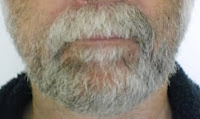 Jon has decided to spend the holiday growing a beard. He had one before I met him, and has always claimed to have remained a man with a beard in spirit. Well, it's coming back, and I think I rather like it. It'll save him shaving, which may be the real reason he's growing it, and I must admit that the idea of cut-throat razors and PD is best avoided. Here's how far he got. V. cuddly.
Even better, I am writing this from our holiday (though burglars beware: we have a very keen cat sitter). The 8+ hour flight really took it out of Jon and it's only now, 6 days in, that he's beginning to feel normal again. Or whatever passes for normal these days.
Once again we have made it all the way through customs with more drugs than anyone has any right to need for the length of time we're away. Although we came with everything in original packets carrying Jon's name, plus copies of prescriptions and a letter from the psychiatrist who prescribed the Ritalin (which apparently has reasonable street value), it's always an anxious time when you face the customs guys. I once got in trouble for carrying half an apple, so what couldn't happen with two gross of class B tablets?
 Jon has decided to spend the holiday growing a beard. He had one before I met him, and has always claimed to have remained a man with a beard in spirit. Well, it's coming back, and I think I rather like it. It'll save him shaving, which may be the real reason he's growing it, and I must admit that the idea of cut-throat razors and PD is best avoided. Here's how far he got. V. cuddly.
29 August 2011
Freedom
MARIE: I’ve just got back from taking Jon to the airport. He’s off to spend a week with the kids in England and I’m sure I speak for both of us when I say yippie!
We used to spend quite a bit of time apart each year before Parkinson’s invaded our lives. We both traveled for work a few times each year and also regularly took separate trips to visit family and friends. In all, we’d maybe spend a month or so apart per year.
And we both loved it. The one going away would naturally be looking forward to whatever awaited, while the one staying home cherished the chance to keep the place exactly “as it should be kept”. Jon would spend his time home alone living in what I would define as deep squalor, while he thinks I kept the place as sterile as a show home without him around to inject a bit of a lived-in feel. Anyway, we would both look forward to the going away, and towards the end of it we’d both start looking forward to the coming home. Those were the days.
Now, of course, neither of us even leaves the house to go to work. Jon doesn’t work at all, and any work I do is mostly done from home. We’ve been together 24/7 this entire summer. Okay, we have separate bedrooms because of Jon’s REM sleep behaviour disorder, but you know what I mean. 24/7. That’s a lot of hours.
There was a program on BBC radio 4 yesterday about the depiction of carers and caring in literature and music. Someone said (and I ought to have made a note of who) that caring deepens your love for the one you care for. That’s certainly true for us. I care for Jon because I love him, and each act of caring confirms the love and strengthens the bond. There were times early on when we both wondered whether we would last the distance together, but there’s no question now that we will.
Nevertheless, a break is wonderfully welcome. I’ve just re-read Hugh Marriott’s excellent book The Selfish Pig’s Guide to Caring which emphasizes the importance of respite care. Not for the sake of the cared-for person (or piglet, as Hugh would have it), but for the carer to draw breath and be a bit selfish just for a little while. I am really beginning to see the point.
With the summer holidays over, the four or so hours Jon spends at his Danish course four days a week serve as my weekly respite, and I get such a lot out of those hours – both in terms of getting things done and in terms of relaxing and not thinking about Jon for a while. As I wrote that last sentence, I realized that Marie of 5 years ago would have absolutely no idea what I could possibly mean by “having four hours off from thinking about Jon”. This caring business is a slippery slope.
So thank providence for Jon’s wonderful daughter who is doing us both a huge favour by having him to stay for a whole, glorious week. I hope they have a wonderful time together and will want to it again and again. I know I’ll have a marvelously selfish week. And I’m sure I’ll really miss Jon by the end of it. How perfect is that?
We used to spend quite a bit of time apart each year before Parkinson’s invaded our lives. We both traveled for work a few times each year and also regularly took separate trips to visit family and friends. In all, we’d maybe spend a month or so apart per year.
And we both loved it. The one going away would naturally be looking forward to whatever awaited, while the one staying home cherished the chance to keep the place exactly “as it should be kept”. Jon would spend his time home alone living in what I would define as deep squalor, while he thinks I kept the place as sterile as a show home without him around to inject a bit of a lived-in feel. Anyway, we would both look forward to the going away, and towards the end of it we’d both start looking forward to the coming home. Those were the days.
Now, of course, neither of us even leaves the house to go to work. Jon doesn’t work at all, and any work I do is mostly done from home. We’ve been together 24/7 this entire summer. Okay, we have separate bedrooms because of Jon’s REM sleep behaviour disorder, but you know what I mean. 24/7. That’s a lot of hours.
There was a program on BBC radio 4 yesterday about the depiction of carers and caring in literature and music. Someone said (and I ought to have made a note of who) that caring deepens your love for the one you care for. That’s certainly true for us. I care for Jon because I love him, and each act of caring confirms the love and strengthens the bond. There were times early on when we both wondered whether we would last the distance together, but there’s no question now that we will.
Nevertheless, a break is wonderfully welcome. I’ve just re-read Hugh Marriott’s excellent book The Selfish Pig’s Guide to Caring which emphasizes the importance of respite care. Not for the sake of the cared-for person (or piglet, as Hugh would have it), but for the carer to draw breath and be a bit selfish just for a little while. I am really beginning to see the point.
With the summer holidays over, the four or so hours Jon spends at his Danish course four days a week serve as my weekly respite, and I get such a lot out of those hours – both in terms of getting things done and in terms of relaxing and not thinking about Jon for a while. As I wrote that last sentence, I realized that Marie of 5 years ago would have absolutely no idea what I could possibly mean by “having four hours off from thinking about Jon”. This caring business is a slippery slope.
So thank providence for Jon’s wonderful daughter who is doing us both a huge favour by having him to stay for a whole, glorious week. I hope they have a wonderful time together and will want to it again and again. I know I’ll have a marvelously selfish week. And I’m sure I’ll really miss Jon by the end of it. How perfect is that?
14 June 2010
Sticks and stones
JON: As you know, we are back from our trip to the USA where a good time was had by all. When we arrived, we allowed ourselves to be upgraded from a compact car to an SUV, and I’m so glad we did. Some of the roads we traveled down really were only passable in a 4x4 SUV, and at one point we came upon a couple who had got stuck in rather a deep puddle of mud in the middle of nowhere. Had we had a rope or even a piece of string we would have had a go at helping, but since we didn’t, all we could do was check that they had phoned for help – and we then had the evil pleasure of effortlessly driving through the morass.
 You are probably aware that the USA is a big place, but you don’t get the full impact of it until you try to cross it by car. We did 3,500 miles in 3 ½ weeks, going from the air conditioned madness of Las Vegas through the baking heat of the Arizona desert and the Grand Canyon to the snow-capped peaks of Yellowstone. I know this may sound like some kind of tourist advert, but it was just amazing. The high spot of the trip was Yellowstone, where we saw elk, bison and black bears, lost each other in the steam of hot springs and marveled at the geysers.
On the PD perspective I did rather well. In the mornings my walking tends to be a bit unsteady, and ditto around the time when my next dose is due, so to a passer-by on the street I probably look as is I’m ever so slightly drunk. Which I don’t mind if it just so happens that I am indeed ever so slightly drunk, but it’s kind of embarrassing on a sober Tuesday at 11 o’clock in the morning. However, I have now solved that problem by buying a walking stick. The difference it made was amazing: people held doors open for me, made space for me on the street, were helpful in shops, etc. I’ve brought the stick back home with me and I’m trying to remember to use it whenever I go out.
In other news, our offer for the house in Denmark has been made and accepted! We won’t exchange keys until November, so there is a strange anti-climax of not much happening at the moment. But I’m looking forward to the move and to getting the place done up just the way I want it. And it’s good to know that we are moving from the time bomb of living across three floors to a much more practical bungalow with wide doors and corridors and no door steps to hamper a shuffling Parkinsonian.
 You are probably aware that the USA is a big place, but you don’t get the full impact of it until you try to cross it by car. We did 3,500 miles in 3 ½ weeks, going from the air conditioned madness of Las Vegas through the baking heat of the Arizona desert and the Grand Canyon to the snow-capped peaks of Yellowstone. I know this may sound like some kind of tourist advert, but it was just amazing. The high spot of the trip was Yellowstone, where we saw elk, bison and black bears, lost each other in the steam of hot springs and marveled at the geysers.
On the PD perspective I did rather well. In the mornings my walking tends to be a bit unsteady, and ditto around the time when my next dose is due, so to a passer-by on the street I probably look as is I’m ever so slightly drunk. Which I don’t mind if it just so happens that I am indeed ever so slightly drunk, but it’s kind of embarrassing on a sober Tuesday at 11 o’clock in the morning. However, I have now solved that problem by buying a walking stick. The difference it made was amazing: people held doors open for me, made space for me on the street, were helpful in shops, etc. I’ve brought the stick back home with me and I’m trying to remember to use it whenever I go out.
In other news, our offer for the house in Denmark has been made and accepted! We won’t exchange keys until November, so there is a strange anti-climax of not much happening at the moment. But I’m looking forward to the move and to getting the place done up just the way I want it. And it’s good to know that we are moving from the time bomb of living across three floors to a much more practical bungalow with wide doors and corridors and no door steps to hamper a shuffling Parkinsonian.
04 June 2010
The good life
 MARIE: We are just back from our long holiday, and what a brilliant time we have had! When Jon was diagnosed three years ago, it was a kind of wake-up call to seize the day and enjoy the good stuff right now, while we both still can. One decision was to take those holidays that we (okay, perhaps particularly I) had been dreaming about, and bugger the costs. If Jon is still up to big holidays in 5 or 10 years’ time, that will be a great bonus, but we’re making sure not to miss out by taking our pleasures up front.
So, soon after diagnosis in 2007 we booked a safari in Tanzania involving some primitive camping which would be beyond Jon today. The next year we took a tour through Cambodia and Vietnam where we rarely stayed more than one night in any one place, also something that would now be a challenge for him. And this year we have again stretched Jon on a holiday through the natural wonders of the western US that may not be possible in a year or two because of the sheer amount of time difference and jetlag. That completes a hat trick of dream holidays, so even if health and finances keep us firmly within Europe for the rest of our lives, that’s okay – we have seen the world, and Jon has thousands of photos to prove it.
 Apart from the grand splendour of canyons and mountains, and the thrill of seeing wild bison and bears, we realized some way through the holiday that we were also thoroughly enjoying taking a break from Parkinson’s. Normally not a day goes by without at least one of us going online to one or more PD chat forums, rarely a week goes by without some PD related appointment or other, our home is filling up with grab poles and back massagers and pill dispensers, and our minds and conversations are often preoccupied with Parkinson’s too. Of course PD came with us on holiday in the form of a sponge bag packed full of drugs, a propensity for late mornings, and a need for me to stand in as occasional grab pole and putter on of socks. But these seemed minor issues, and on the whole this was a well-earned break from all things disease-related.
Normal life is now gradually resuming. The suitcases are empty and the fridge full again, we have waded through tons of post and email, have (at last) put in an offer for the bungalow that we hope to move to before the end of the year, and are ready to engage again with the vexed and vexing issue of Jon’s medication schedule. Now, even the blog post is now done. The sun is shining, the tea is brewing, and all is well with our world.
06 May 2010
Cause for celebration
 JON: As you can see, there has been great excitement in our village this week as “we” have celebrated first the Queen’s birthday and then the 65th anniversary of liberation which is a big deal around here – in fact, A bridge too far (the film) happened more or less down the road from us. Much bunting and several parades, the highlight of the village year!
Anyway, despite a visit earlier today to our psychologist, aimed at starting to unravel the great taboo subject of whether I should be
 ‘allowed’ to take my medication as I want, Marie and I have managed to remain on excellent terms (nudge, nudge). Which is particularly fortunate, as we are soon to embark on a three-week tour of the USA starting in Las Vegas and ending in the Yellowstone National Park. I predict it’s going to be great! We may come across the occasional Internet café and keep you up to date, but most likely you’ll just have to wait until we are back for details.
Although I have to confess that in a fit of retail therapy I bought a new mobile phone. It may or may not work in the US (previous phones have not). It has all the bells and whistles an old techie could wish for: MP3 player, camera, internet access, all sorts of connectivities – and because it’s an Android phone it will even let me play with programming my
 own applets. So far, set-up has required one visit back to the shop and two total resets of the device. I actually think this is great as the thing is sure to keep me occupied for weeks and weeks. One of the best toys I’ve had in a long time.
Anyway, we shall leave cyberspace to its own devices while we’re away, and leave the house in the capable forelimbs of the cat and his cat-sitter – the girl from next door, who has a large family and therefore enjoys the quiet (and undisputed control of the TV remote) that she finds in our house when we’re away. Marie has shown me the evidence that a mole has also recently moved in, so the place will be full of life in our absence.
We leave you with the news that as our ‘fame’ spreads, we now have over 200 readers in countries ranging from Norway to Nigeria. We seem to be going global. Parkinson’s rules!
24 October 2009
Pacing ourselves
MARIE: We’re recently back from holiday, where we made more or less a circle by car from home in The Netherlands through a few days in Bruges in Belgium, a week in a chalet in the Loire Valley in France, and a couple of days visiting friends in Luxemburg on the way home.
There were a couple of firsts involved. This was our first driving holiday together and partly served as a taster / tester for a trip we are hoping to make in the spring, driving through the national parks of the Western US. Since Jon now only drives shorter distances that he is already familiar with, I did all the driving. Would that exhaust me? Would we bicker about directions and the need for breaks? Would Jon’s back complain at the amount of enforced sitting? Happily, the answer in all cases was NO. Our GPS (known as Mrs Tom) played a big part in this, but we also found that this is a holiday form that suits us both, at least for now.
This was also the first holiday Jon has ever suggested in all the time we have known each other. For the last 16 years, every holiday we have been on has been my idea – even most (but not quite all) of our visits to see Jon’s children and grandchildren have been suggested and organized by me. It was so nice, just really nice, that for once I didn’t have to convince and cajole him, but could sit back and think that “yes, that sounds like a pretty good idea – okay, let’s do it”. A first, but hopefully not a last. Admittedly, the reason behind it is that my one-time workaholic husband now finds himself with too much time on his hands and not enough energy to spend it in a productive manner. But I count this holiday (and those to follow?) as a thick silver lining.
Lastly, this is the first holiday where we have had to fit our activities around Jon’s medication regime and periods of wearing off. He is still struggling with strangely slow effects of his drugs, and fairly short periods of optimal effects. He takes a dose every four hours, but each dose only gives him about 2 ½ hours of peak condition, which obviously means 1 ½ hours out of every four hours when he is slow (both physically and mentally), tired and often in some discomfort.
It is an evolving task to find the right pattern of daily activities to fit around Jon’s ups and downs. We would regularly get in the car when Jon was on top of the world, only to find that by the time we arrived at our destination he would be hunched and shuffling and in no fit state to enjoy anything other than a sit down. So we spent much time enjoying the late summer sun in the street cafés thoughtfully provided by the tourist industry, and less time exploring monasteries and castles and medieval town centres (which I am sure suited Jon absolutely fine). We also fell into a rhythm of doing much one day and little the next, giving him time to rest and both of us time to make a good dent in the large pile of books we had brought with us.
These are obviously patterns that we must also make room for on future holidays, so perhaps our days of traveling in small groups with a guide are over, and perhaps we have to adjust our rather ambitious itinerary plans for the US trip. But what is also clear is that holidays are still very much an option and highly enjoyable for us both – so long as we allow for the fact that Dr Parkinson is our constant, invisible companion.
There were a couple of firsts involved. This was our first driving holiday together and partly served as a taster / tester for a trip we are hoping to make in the spring, driving through the national parks of the Western US. Since Jon now only drives shorter distances that he is already familiar with, I did all the driving. Would that exhaust me? Would we bicker about directions and the need for breaks? Would Jon’s back complain at the amount of enforced sitting? Happily, the answer in all cases was NO. Our GPS (known as Mrs Tom) played a big part in this, but we also found that this is a holiday form that suits us both, at least for now.
This was also the first holiday Jon has ever suggested in all the time we have known each other. For the last 16 years, every holiday we have been on has been my idea – even most (but not quite all) of our visits to see Jon’s children and grandchildren have been suggested and organized by me. It was so nice, just really nice, that for once I didn’t have to convince and cajole him, but could sit back and think that “yes, that sounds like a pretty good idea – okay, let’s do it”. A first, but hopefully not a last. Admittedly, the reason behind it is that my one-time workaholic husband now finds himself with too much time on his hands and not enough energy to spend it in a productive manner. But I count this holiday (and those to follow?) as a thick silver lining.
Lastly, this is the first holiday where we have had to fit our activities around Jon’s medication regime and periods of wearing off. He is still struggling with strangely slow effects of his drugs, and fairly short periods of optimal effects. He takes a dose every four hours, but each dose only gives him about 2 ½ hours of peak condition, which obviously means 1 ½ hours out of every four hours when he is slow (both physically and mentally), tired and often in some discomfort.
It is an evolving task to find the right pattern of daily activities to fit around Jon’s ups and downs. We would regularly get in the car when Jon was on top of the world, only to find that by the time we arrived at our destination he would be hunched and shuffling and in no fit state to enjoy anything other than a sit down. So we spent much time enjoying the late summer sun in the street cafés thoughtfully provided by the tourist industry, and less time exploring monasteries and castles and medieval town centres (which I am sure suited Jon absolutely fine). We also fell into a rhythm of doing much one day and little the next, giving him time to rest and both of us time to make a good dent in the large pile of books we had brought with us.
These are obviously patterns that we must also make room for on future holidays, so perhaps our days of traveling in small groups with a guide are over, and perhaps we have to adjust our rather ambitious itinerary plans for the US trip. But what is also clear is that holidays are still very much an option and highly enjoyable for us both – so long as we allow for the fact that Dr Parkinson is our constant, invisible companion.
20 August 2009
Typical Parkinson's
I saw my personal shrink for the first time a few weeks ago. He specializes in Parkinson’s – not the physical manifestations, but the mental ones. He described me to myself quite accurately (i.e. I am typical for a Parkinsonian). And although I claimed to be apathetic, and he argued that I suffered from a lack of drive (typical P). And much as I hate to say it he could be right, so my next claim is that it’s just a matter of semantics.
I’m also mildly offended to be described as typical – I’m special, me. I want the phrase “when you have seen one case of Parkinson’s, you have seen one case of Parkinson’s” to be true. Although I can now spot a fellow Parkinsonian from 50 paces – the slow shuffle, the stiff arms, the sticky feet etc. – I am still sure each and every one of us has our own idiosyncrasies.
I seem to oscillate between on the one hand claiming that I’m very, very sick, as if I’m not going to be believed, and on the other hand shrugging it off as “just one of those things” and trying to pretend there are no problems – but if I’m that healthy in mind and body what am I doing seeing my own personal shrink? (Actually the plan is to have part of the session as a couple and part to each ourselves, but I suspect the couple stuff will also be focused on me.)
The pills also have a large effect on my mood; I bounce from lethargic couch potato to pacing panther when I endlessly walk from one end of the living room to the other in the same way that animals in zoos trace out stereotypical behaviours. Shrink is on holiday so there will be a month between first and second visit, more than enough time to ponder my mental condition.
My physiotherapist is also on holiday, but to make sure I got no rest I had an appointment with the speech therapist, the first in 3 months. The good news is that she saw no change. I, on the other hand, have started having minor difficulties swallowing, and some cheek and tongue biting. Minor symptoms, I know, but worrying nonetheless – and I probably focus on them particularly because of background in dentistry and research on the mechanics of eating.
Last week we saw my neurologist who had the report from the evaluation at ParkNet. We mainly discussed drugs, dosage, timing, etc. It feels to me that we now have the correct drug cocktail, all the right ingredients, so all we have to do now is fine tune the dosage(s) and timing(s). We also had an appointment with the Parkinson’s specialist nurse, though it turned out she didn’t know why she was seeing me and neither did I. But we had a nice chat, and it was reassuring in a way – she was the first person to imply that I was doing OK and that she didn’t see any major deterioration.
It’s been hot and humid again. Marie was away for a week in Korea which I spent sweating and ignoring the blog, computer and cat. The cat, however, makes its wishes known with sharp claws, mainly demanding food, but sometimes angling for affection (a bit like me, really).
My next task is to organize the itinerary for our holiday – a week of random driving through the French country-side and a week in a remote cottage. I plan to keep this as unplanned and random as possible, but Marie has other ideas – though I think we can come to some kind of compromise (i.e. we may be spontaneous on Tuesdays and Thursdays, and for the other days we will have a detailed route map plotted into Mrs Tomtom – “At the roundabout, turn left”).
And now as I write I notice my typing is getting a bit blurry, so it’s pill time again ...
I’m also mildly offended to be described as typical – I’m special, me. I want the phrase “when you have seen one case of Parkinson’s, you have seen one case of Parkinson’s” to be true. Although I can now spot a fellow Parkinsonian from 50 paces – the slow shuffle, the stiff arms, the sticky feet etc. – I am still sure each and every one of us has our own idiosyncrasies.
I seem to oscillate between on the one hand claiming that I’m very, very sick, as if I’m not going to be believed, and on the other hand shrugging it off as “just one of those things” and trying to pretend there are no problems – but if I’m that healthy in mind and body what am I doing seeing my own personal shrink? (Actually the plan is to have part of the session as a couple and part to each ourselves, but I suspect the couple stuff will also be focused on me.)
The pills also have a large effect on my mood; I bounce from lethargic couch potato to pacing panther when I endlessly walk from one end of the living room to the other in the same way that animals in zoos trace out stereotypical behaviours. Shrink is on holiday so there will be a month between first and second visit, more than enough time to ponder my mental condition.
My physiotherapist is also on holiday, but to make sure I got no rest I had an appointment with the speech therapist, the first in 3 months. The good news is that she saw no change. I, on the other hand, have started having minor difficulties swallowing, and some cheek and tongue biting. Minor symptoms, I know, but worrying nonetheless – and I probably focus on them particularly because of background in dentistry and research on the mechanics of eating.
Last week we saw my neurologist who had the report from the evaluation at ParkNet. We mainly discussed drugs, dosage, timing, etc. It feels to me that we now have the correct drug cocktail, all the right ingredients, so all we have to do now is fine tune the dosage(s) and timing(s). We also had an appointment with the Parkinson’s specialist nurse, though it turned out she didn’t know why she was seeing me and neither did I. But we had a nice chat, and it was reassuring in a way – she was the first person to imply that I was doing OK and that she didn’t see any major deterioration.
It’s been hot and humid again. Marie was away for a week in Korea which I spent sweating and ignoring the blog, computer and cat. The cat, however, makes its wishes known with sharp claws, mainly demanding food, but sometimes angling for affection (a bit like me, really).
My next task is to organize the itinerary for our holiday – a week of random driving through the French country-side and a week in a remote cottage. I plan to keep this as unplanned and random as possible, but Marie has other ideas – though I think we can come to some kind of compromise (i.e. we may be spontaneous on Tuesdays and Thursdays, and for the other days we will have a detailed route map plotted into Mrs Tomtom – “At the roundabout, turn left”).
And now as I write I notice my typing is getting a bit blurry, so it’s pill time again ...
09 March 2009
Success and reward
I did it! I gave the lecture and it was, well, sort of OK. I didn’t freeze, turn to jelly or have a panic attack. I didn’t get a round of applause either, nor any questions from the students, but no one fell asleep and I think they actually absorbed some information, and I count that as a pretty decent achievement for 8:30 on a Monday morning.
I hadn’t realized how much giving the lecture would take out of me. I was ratty for days before giving the lecture and drained for days afterwards. It was good to prove (mainly to myself) that I could do it, but considering the effort involved I’m not sure I’ll volunteer to do it again.
A few days later I had an appointment with My Neurologist. What to tell her? What to ask? Things have been on a more or less even keel for the past month or two. The L-dopa is not quite as effective as it was, sleeping is still less than perfect, but generally I am content enough. We adjusted the medication a bit so I now take a controlled release Sinemet (L-Dopa) at night which stops me waking myself up by twitching, and I still take a sleeping pill to combat the mild REM-sleep disorder. The combination seems to work fairly well for me.
Marie is more sceptical. I don’t leap out of bed in the morning, bright-eyed and bushy-tailed, and I go to bed earlier and earlier, plus I take naps during the day - so I suppose I’m not that much fun to be around. Apathy, I think, or is it lethargy? One would be down to me, the other a common symptom of the disease. The jury remains out.
I have managed to work up some enthusiasm for the book I am writing, though. I’ve been rummaging around the internet for data on the fluid dynamics of the large intestine - no really, it’s fascinating stuff and there does not seem to have been much work done on it, although the basic physics seem to be fairly simple(ish). Anyhow, I’ve now got an interesting set of equations and suspect that if I torture them for long enough they might yield something useful.
In the much shorter term, we had been thinking of taking a short last-minute holiday – partly to see if this would agree with us as we have never taken a charter holiday together before, and generally expect and enjoy rather different things holiday-wise. In principle, I’d be happy to turn up at the airport some day and see what is on offer, but we decided to be a bit more conventional. Egypt’s Red Sea coast and snorkeling appealed to both of us – sun, beaches, warm(ish) water, and on the all inclusive packages even the drinks are free. There was a time when this would have been very attractive to me, but my total consumption of alcohol for the year to departure date was one beer, which was 100% more than Marie (oh, we are such fun-loving people to hang with...)
In the end, we booked using a method called hotel bingo. The deal was we did not get told which hotel we would be at BUT we were guaranteed a 5-star week for the price of a 4-star holiday. It worked well. We were met at the airport, shepherded onto a bus, and when we got to the hotel were fitted with a plastic bracelet which gave us free access copious quantities of food and drink. Two surprises: I took far more advantage of the latter than I had expected, and the other guests took far less, which together made for rather an idyllic time.
We had worried that we might get bored stiff sitting round the pool all day doing nothing, but we weren’t and we didn’t. We booked 3 trips: an outing in a ‘submarine’ to look at the spectacular coral reefs, a boat trip to the nearby marine national park Ras Mohammed where we snorkeled at three sites, and a jeep trip across the desert to another great snorkeling site.
I restricted myself to two episodes of snorkeling. It was spectacular, and our guide took pity on me and appointed himself my outboard motor. So I held on to a rubber ring while he swam ahead dragging me though the water at impressive speeds – I could have water skied behind the bloke. Anyhow, after the first two dives I decided enough was enough. While gravity made getting into the water ever so easy, the reverse was a bit more challenging...
Anyhow, we are now back in the flat land where it is damp and chilly, but where the cat was ecstatically happy to see us. Ahhh.
I hadn’t realized how much giving the lecture would take out of me. I was ratty for days before giving the lecture and drained for days afterwards. It was good to prove (mainly to myself) that I could do it, but considering the effort involved I’m not sure I’ll volunteer to do it again.
A few days later I had an appointment with My Neurologist. What to tell her? What to ask? Things have been on a more or less even keel for the past month or two. The L-dopa is not quite as effective as it was, sleeping is still less than perfect, but generally I am content enough. We adjusted the medication a bit so I now take a controlled release Sinemet (L-Dopa) at night which stops me waking myself up by twitching, and I still take a sleeping pill to combat the mild REM-sleep disorder. The combination seems to work fairly well for me.
Marie is more sceptical. I don’t leap out of bed in the morning, bright-eyed and bushy-tailed, and I go to bed earlier and earlier, plus I take naps during the day - so I suppose I’m not that much fun to be around. Apathy, I think, or is it lethargy? One would be down to me, the other a common symptom of the disease. The jury remains out.
I have managed to work up some enthusiasm for the book I am writing, though. I’ve been rummaging around the internet for data on the fluid dynamics of the large intestine - no really, it’s fascinating stuff and there does not seem to have been much work done on it, although the basic physics seem to be fairly simple(ish). Anyhow, I’ve now got an interesting set of equations and suspect that if I torture them for long enough they might yield something useful.
In the much shorter term, we had been thinking of taking a short last-minute holiday – partly to see if this would agree with us as we have never taken a charter holiday together before, and generally expect and enjoy rather different things holiday-wise. In principle, I’d be happy to turn up at the airport some day and see what is on offer, but we decided to be a bit more conventional. Egypt’s Red Sea coast and snorkeling appealed to both of us – sun, beaches, warm(ish) water, and on the all inclusive packages even the drinks are free. There was a time when this would have been very attractive to me, but my total consumption of alcohol for the year to departure date was one beer, which was 100% more than Marie (oh, we are such fun-loving people to hang with...)
In the end, we booked using a method called hotel bingo. The deal was we did not get told which hotel we would be at BUT we were guaranteed a 5-star week for the price of a 4-star holiday. It worked well. We were met at the airport, shepherded onto a bus, and when we got to the hotel were fitted with a plastic bracelet which gave us free access copious quantities of food and drink. Two surprises: I took far more advantage of the latter than I had expected, and the other guests took far less, which together made for rather an idyllic time.
We had worried that we might get bored stiff sitting round the pool all day doing nothing, but we weren’t and we didn’t. We booked 3 trips: an outing in a ‘submarine’ to look at the spectacular coral reefs, a boat trip to the nearby marine national park Ras Mohammed where we snorkeled at three sites, and a jeep trip across the desert to another great snorkeling site.
I restricted myself to two episodes of snorkeling. It was spectacular, and our guide took pity on me and appointed himself my outboard motor. So I held on to a rubber ring while he swam ahead dragging me though the water at impressive speeds – I could have water skied behind the bloke. Anyhow, after the first two dives I decided enough was enough. While gravity made getting into the water ever so easy, the reverse was a bit more challenging...
Anyhow, we are now back in the flat land where it is damp and chilly, but where the cat was ecstatically happy to see us. Ahhh.
30 December 2008
Time and its purpose
Hello, it’s Marie writing again. Is that because Jon is too busy to blog this week? Well, that’s exactly what he has agreed to let me talk about.
Jon has been on sick leave since early August, so getting on for 5 months. By law, he has been seen about every six weeks by a doctor appointed by his employer. This is Holland, though, so the doctor is not just there to catch out malingerers but also to assess whether people with long-term conditions, such as Jon, can somehow be eased back into some level of structured work. So far, the doctor has deemed at each visit that Jon is totally unfit for work and has apparently not felt there was any point in the employer making any special concessions since, presumably, this would be unlikely to have much effect.
At the same time, both Jon and I and the neurologist believe that Jon is now just about as well as he is ever going to be, physically and cognitively. He struggles with stiffness and difficulty bending and twisting (he said in an early blog that he now eats like a hobbit, but he sure moves more like an Ent), he tires easily both physically and mentally, and he still has some issues with short-term memory – though it is vastly better than on the previous PD meds.
So does that mean Jon will in fact never work again? We suspect that may in fact be the case. Whether or not you can continue in normal paid employment with Parkinson’s obviously depends to some extent on what your job is. So Jon has been able to continue working longer as a research scientist than he would have managed had he been a dentist in need of fine motor skills. On the other hand, with a less cognitively demanding job better suited to part-time working he might still have been able to carry on for some time longer. Hard to say, and I guess you just have to go with the hand you are dealt.
Let’s leave the mildly terrifying issue of what that means for our finances to one side – whatever happens, we will still be vastly better off than most people on the globe, so no whining (yet). Much more importantly right now is the question of what Jon is in fact supposed to do with himself and his time.
What does he want to do, what is he able to do, how much can he commit to doing? He has said in earlier blogs that there are many interesting and rewarding things he would like to do, and that he probably could do now although at a much reduced pace. He has several ideas for books he would like to write alone or with old colleagues, he continues to act as peer reviewer for several scientific journals, and he is kind of keen on the idea of taking up artsy photography, and he likes the idea of frequent holidays to interesting places. In the good old days before Parkinson’s, Jon was a complete monomaniac, totally obsessed with his work, so in a way I welcome these slightly broader interests.
BUT: what does Jon actually get done, then? Very little indeed, as far as I can see. And it’s hard, you know. Anyone who has had an extended period of unemployment knows how time just crumbles away to no purpose when you have too much of it. And even when you have something you want to do, a fairly clear goal, having too much time in which to achieve it – indeed, having no deadlines except those you set for yourself, and no colleagues or customers waiting for you to finish the task – can mean that nothing much gets achieved at all.
When you have all the time in the world, everything can wait until tomorrow, and nothing much matters anyway. So you end up sleeping late, wandering around the house in your dressing gown until midday, filling empty hours with pointless day-time TV. I know, I have been there, and now Jon is there. It’s not a happy, satisfying place to be – a break is only a break when it is a break from something; alone it cannot fill your life with any degree of satisfaction. And I can see that it is harder for Jon to find the motivation to dig himself out of this hole than it might be for most, because whatever task or hobby he takes on, he cannot be sure that the disease will allow him to continue or to finish it.
So what can one do? Well, we talk (some) and I try not to be too moralistic and prescriptive. We have also talked to our psychologist about it, and I should think we will again – he does ask some really incisive questions that we both spend quite some time mulling over. One area we both have to work on is sharing household responsibilities, partly as a way of giving some structure and purpose to Jon’s days. And now one of Jon’s co-authors on the book he has not been writing has set them both the challenge of finishing a draft chapter each by next weekend. Maybe that will kick-start something.
I just so wish that Jon could get really excited about something, the way he used to do. I miss the Jon who was so deeply engaged in whatever he was doing that the outside world (and me with it) just disappeared into insignificance. I don’t suppose that Jon exists anymore, but some approximation would be so very good
Jon has been on sick leave since early August, so getting on for 5 months. By law, he has been seen about every six weeks by a doctor appointed by his employer. This is Holland, though, so the doctor is not just there to catch out malingerers but also to assess whether people with long-term conditions, such as Jon, can somehow be eased back into some level of structured work. So far, the doctor has deemed at each visit that Jon is totally unfit for work and has apparently not felt there was any point in the employer making any special concessions since, presumably, this would be unlikely to have much effect.
At the same time, both Jon and I and the neurologist believe that Jon is now just about as well as he is ever going to be, physically and cognitively. He struggles with stiffness and difficulty bending and twisting (he said in an early blog that he now eats like a hobbit, but he sure moves more like an Ent), he tires easily both physically and mentally, and he still has some issues with short-term memory – though it is vastly better than on the previous PD meds.
So does that mean Jon will in fact never work again? We suspect that may in fact be the case. Whether or not you can continue in normal paid employment with Parkinson’s obviously depends to some extent on what your job is. So Jon has been able to continue working longer as a research scientist than he would have managed had he been a dentist in need of fine motor skills. On the other hand, with a less cognitively demanding job better suited to part-time working he might still have been able to carry on for some time longer. Hard to say, and I guess you just have to go with the hand you are dealt.
Let’s leave the mildly terrifying issue of what that means for our finances to one side – whatever happens, we will still be vastly better off than most people on the globe, so no whining (yet). Much more importantly right now is the question of what Jon is in fact supposed to do with himself and his time.
What does he want to do, what is he able to do, how much can he commit to doing? He has said in earlier blogs that there are many interesting and rewarding things he would like to do, and that he probably could do now although at a much reduced pace. He has several ideas for books he would like to write alone or with old colleagues, he continues to act as peer reviewer for several scientific journals, and he is kind of keen on the idea of taking up artsy photography, and he likes the idea of frequent holidays to interesting places. In the good old days before Parkinson’s, Jon was a complete monomaniac, totally obsessed with his work, so in a way I welcome these slightly broader interests.
BUT: what does Jon actually get done, then? Very little indeed, as far as I can see. And it’s hard, you know. Anyone who has had an extended period of unemployment knows how time just crumbles away to no purpose when you have too much of it. And even when you have something you want to do, a fairly clear goal, having too much time in which to achieve it – indeed, having no deadlines except those you set for yourself, and no colleagues or customers waiting for you to finish the task – can mean that nothing much gets achieved at all.
When you have all the time in the world, everything can wait until tomorrow, and nothing much matters anyway. So you end up sleeping late, wandering around the house in your dressing gown until midday, filling empty hours with pointless day-time TV. I know, I have been there, and now Jon is there. It’s not a happy, satisfying place to be – a break is only a break when it is a break from something; alone it cannot fill your life with any degree of satisfaction. And I can see that it is harder for Jon to find the motivation to dig himself out of this hole than it might be for most, because whatever task or hobby he takes on, he cannot be sure that the disease will allow him to continue or to finish it.
So what can one do? Well, we talk (some) and I try not to be too moralistic and prescriptive. We have also talked to our psychologist about it, and I should think we will again – he does ask some really incisive questions that we both spend quite some time mulling over. One area we both have to work on is sharing household responsibilities, partly as a way of giving some structure and purpose to Jon’s days. And now one of Jon’s co-authors on the book he has not been writing has set them both the challenge of finishing a draft chapter each by next weekend. Maybe that will kick-start something.
I just so wish that Jon could get really excited about something, the way he used to do. I miss the Jon who was so deeply engaged in whatever he was doing that the outside world (and me with it) just disappeared into insignificance. I don’t suppose that Jon exists anymore, but some approximation would be so very good
22 December 2008
What we did on holiday
I have no intention of showing you all (or indeed any) of our 2000+ slides or of going into great detail, so suffice it to say we went on a guided tour through Cambodia, Vietnam and Singapore, and we had a great time.
We booked the trip earlier in the year when we were pretty optimistic about my health, and had some worrying months while I went downhill, so my improvement on the new PD meds came in the nick of time. In fact, having the new sleeping pills meant that I suffered much less jet lag than others in our group because I could control my sleep. And bliss, oh bliss, I was (and still am) sleeping normally – or what passes for normal when you have Parkinson’s and jerk about when you dream.
Going as part of a group (of 12) meant that I didn’t feel guilty about opting out of a few activities as that would not leave Marie with no-one to share with. So, instead of climbing about temples or crawling through Vietcong tunnels, I could take a nap in the bus and wait for the others (including an overweight and hyper-energetic 75-year-old grandmother) to get back. It also helped that everyone we travelled with, both tourists and guides, were really helpful and understanding. My bags were carried for me, I had first choice of seats, and was expertly handed in and out of numerous boats.
Another thing is that one of the symptoms that has had me most worried was my sudden aversion to coffee starting about 18 months ago. I used to drink gallons of the stuff, but suddenly it had a powerful acrid/burning smell. But I noted to my great delight that Vietnamese coffee smelt like coffee used to do. The difference, I think, is that the Viet coffee is sweetened with condensed milk (8% fat) and I suspect the high fat content absorbs whatever unpleasant component it is that I have become sensitized to. Oh, yes, and after very thorough testing I can also confirm that I now appear to tolerate beer really rather well again…
The last two days of the trip were interesting. Marie sprained her ankle getting onto the bus from the airport to the hotel. It looked painful and she said it was painful, but after sleeping with her foot in a bag of ice and borrowing a crutch from the concierge she was keen to do the night safari at Singapore zoo. I found it exhausting jogging to keep up with the woman. But seriously, you should have seen us when we first arrived at the hotel: she hobbled painfully straight to bed whence she directed me to ring for ice and fetch towels and pillows and dig out the painkillers and get the door and put the kettle on – and I performed a perfect pantomime of rushing around in slow motion. But it was good to be the one doing for once, rather than being done for.
So was the trip worth it? Yes, definitely – we got to spend a lot of time together in a stress-free environment, we got to feel immensely lucky and privileged compared to the locals, and we got to see and do and eat a lot of new and interesting stuff.
Back home, I have noticed that I am not doing so well on memory issues. Other people my age joke about senior moments, like when I forgot the name of the Prime Minister. Embarrassing at least, somewhat worrying at worst – I retrieved the name after 10-15 seconds, but they were a long few seconds. With Parkinson's, you know there’s a greater risk of dementia, so it’s harder to laugh off the lapses in memory. Do these lapses affect my ability to work? Well, I had another of my regular assessments with the work doctor who claimed to detect a slight improvement since he last saw me two months ago. He may be right, although I’m tempted to put my apparent improvement down to the mild sun tan I picked up whilst away. Anyhow, I’m still assessed as 0% fit for work, it just may be a slightly smaller zero this time.
We booked the trip earlier in the year when we were pretty optimistic about my health, and had some worrying months while I went downhill, so my improvement on the new PD meds came in the nick of time. In fact, having the new sleeping pills meant that I suffered much less jet lag than others in our group because I could control my sleep. And bliss, oh bliss, I was (and still am) sleeping normally – or what passes for normal when you have Parkinson’s and jerk about when you dream.
Going as part of a group (of 12) meant that I didn’t feel guilty about opting out of a few activities as that would not leave Marie with no-one to share with. So, instead of climbing about temples or crawling through Vietcong tunnels, I could take a nap in the bus and wait for the others (including an overweight and hyper-energetic 75-year-old grandmother) to get back. It also helped that everyone we travelled with, both tourists and guides, were really helpful and understanding. My bags were carried for me, I had first choice of seats, and was expertly handed in and out of numerous boats.
Another thing is that one of the symptoms that has had me most worried was my sudden aversion to coffee starting about 18 months ago. I used to drink gallons of the stuff, but suddenly it had a powerful acrid/burning smell. But I noted to my great delight that Vietnamese coffee smelt like coffee used to do. The difference, I think, is that the Viet coffee is sweetened with condensed milk (8% fat) and I suspect the high fat content absorbs whatever unpleasant component it is that I have become sensitized to. Oh, yes, and after very thorough testing I can also confirm that I now appear to tolerate beer really rather well again…
The last two days of the trip were interesting. Marie sprained her ankle getting onto the bus from the airport to the hotel. It looked painful and she said it was painful, but after sleeping with her foot in a bag of ice and borrowing a crutch from the concierge she was keen to do the night safari at Singapore zoo. I found it exhausting jogging to keep up with the woman. But seriously, you should have seen us when we first arrived at the hotel: she hobbled painfully straight to bed whence she directed me to ring for ice and fetch towels and pillows and dig out the painkillers and get the door and put the kettle on – and I performed a perfect pantomime of rushing around in slow motion. But it was good to be the one doing for once, rather than being done for.
So was the trip worth it? Yes, definitely – we got to spend a lot of time together in a stress-free environment, we got to feel immensely lucky and privileged compared to the locals, and we got to see and do and eat a lot of new and interesting stuff.
Back home, I have noticed that I am not doing so well on memory issues. Other people my age joke about senior moments, like when I forgot the name of the Prime Minister. Embarrassing at least, somewhat worrying at worst – I retrieved the name after 10-15 seconds, but they were a long few seconds. With Parkinson's, you know there’s a greater risk of dementia, so it’s harder to laugh off the lapses in memory. Do these lapses affect my ability to work? Well, I had another of my regular assessments with the work doctor who claimed to detect a slight improvement since he last saw me two months ago. He may be right, although I’m tempted to put my apparent improvement down to the mild sun tan I picked up whilst away. Anyhow, I’m still assessed as 0% fit for work, it just may be a slightly smaller zero this time.
06 November 2008
Off on tour
My daughter and baby grandson visited last week (hence too much excitement to find time to blog – sorreee). It gave me a real boost to have them here. Not that we actually did much as such, other than a few walks and meals, but that is how I like it best: behaving like we have all the time in the world even if we live hundreds of miles apart. It was particularly good to be able to demonstrate that although Parkinson’s is obviously not going to go away, I am a lot better now than I was last time I saw my daughter.
Drugswise, I have now been Sifrol-free for three weeks and have, I think, just about found the right dose of Sinemet (proper L-dopa). And the change has worked wonders both physically and cognitively. I’m not back to my old self from before the disease set in, but I am at a level that can deliver a perfectly acceptable quality of life. And it’s not just me saying that, either. I had another of my regular assessments by the works doctor, who saw a great deal of improvement. He suggested occupational therapy might be a good idea, and I agree absolutely. Although the idea of retirement at 55 has its temptations, I suspect that doing something useful is actually better for the soul.
Somewhat disappointingly, though, it turns out that the doctor thinks the various tasks I have already devised for myself to do at home constitute sufficient occupational therapy for now. Oh well – I guess the only thing work would be able to suggest would be editing scientific papers for colleagues who need their English checking, which would be neither particularly interesting nor stressful. BTW, since I was in the building anyway, I poked my head round my old door and found that my desk has already been reassigned to someone else. Is that some kind of heavy hint?
Anyway, I am in fact pretty busy at home this week. We’re off on a 3-week holiday this weekend and there is a whole list of things to do before we leave. I promised to write some simple software and have just one last bug to fix before I can deliver (which will be a small triumph, considering my failure with another simple programming task earlier this year). It’s for a study where we measure reaction times with and without a background aroma which is a bit too close to aromatherapy for my comfort, actually. I mean, how open a mind can you keep before your brain falls out?
Also, I foolishly agreed to review a scientific paper. This is normally a simple task: either respond that YES, this is quality work that should be published forthwith or NO, this is derivative rubbish. Unfortunately, while the paper I’ve been given appears to be okay scientifically, the English is so abysmal that it is backbreaking work to suss out exactly what the authors mean. Until I’ve translated the thing into something more readily comprehensible I cannot be sure which way my thumb should point.
And I have to write a 4-page potted autobiography for our shrink, who we saw for the first time two weeks ago. The referral we had from our GP stated that the aim was to make life with PD liveable, and that strikes me as a fine ambition. One early hurdle – or perhaps the major, or even only hurdle – is to reconcile the diametrically opposite ways that Marie and I each deal with and react to my PD. To which end he has asked us each for a short history of how we became the people we are today. How does one fit a life onto 4 pages? My work CV alone runs to 18 pages. Well, I suppose I could leave out the dull bits, but then how would I fill the other 3 pages? No seriously, there must be 4 pages worth of almost interesting stuff in 55 years of life – ‘your mother did what?!? No wonder you’re messed up!’
Last but by no means least, I have to pack. We’ll be travelling through Cambodia, Vietnam and Singapore. Now, according to CNN’s weather forecast, most of Southeast Asia is under water, suffering the worst floods for many years, so I expect humid and muddy and frequent changes of clothes. We’ll be on a tour with up to 10 other tourists and I also can’t help but worry that I might hold everyone up as I struggle in and out of car seats or delay morning departures because the drugs haven’t kicked in enough to allow me to get dressed. However, I suspect this could be my basic glass-half-empty approach kicking in and that in fact I will have rather a brilliant time. I’ll be back again to tell you about it in the beginning of December.
Drugswise, I have now been Sifrol-free for three weeks and have, I think, just about found the right dose of Sinemet (proper L-dopa). And the change has worked wonders both physically and cognitively. I’m not back to my old self from before the disease set in, but I am at a level that can deliver a perfectly acceptable quality of life. And it’s not just me saying that, either. I had another of my regular assessments by the works doctor, who saw a great deal of improvement. He suggested occupational therapy might be a good idea, and I agree absolutely. Although the idea of retirement at 55 has its temptations, I suspect that doing something useful is actually better for the soul.
Somewhat disappointingly, though, it turns out that the doctor thinks the various tasks I have already devised for myself to do at home constitute sufficient occupational therapy for now. Oh well – I guess the only thing work would be able to suggest would be editing scientific papers for colleagues who need their English checking, which would be neither particularly interesting nor stressful. BTW, since I was in the building anyway, I poked my head round my old door and found that my desk has already been reassigned to someone else. Is that some kind of heavy hint?
Anyway, I am in fact pretty busy at home this week. We’re off on a 3-week holiday this weekend and there is a whole list of things to do before we leave. I promised to write some simple software and have just one last bug to fix before I can deliver (which will be a small triumph, considering my failure with another simple programming task earlier this year). It’s for a study where we measure reaction times with and without a background aroma which is a bit too close to aromatherapy for my comfort, actually. I mean, how open a mind can you keep before your brain falls out?
Also, I foolishly agreed to review a scientific paper. This is normally a simple task: either respond that YES, this is quality work that should be published forthwith or NO, this is derivative rubbish. Unfortunately, while the paper I’ve been given appears to be okay scientifically, the English is so abysmal that it is backbreaking work to suss out exactly what the authors mean. Until I’ve translated the thing into something more readily comprehensible I cannot be sure which way my thumb should point.
And I have to write a 4-page potted autobiography for our shrink, who we saw for the first time two weeks ago. The referral we had from our GP stated that the aim was to make life with PD liveable, and that strikes me as a fine ambition. One early hurdle – or perhaps the major, or even only hurdle – is to reconcile the diametrically opposite ways that Marie and I each deal with and react to my PD. To which end he has asked us each for a short history of how we became the people we are today. How does one fit a life onto 4 pages? My work CV alone runs to 18 pages. Well, I suppose I could leave out the dull bits, but then how would I fill the other 3 pages? No seriously, there must be 4 pages worth of almost interesting stuff in 55 years of life – ‘your mother did what?!? No wonder you’re messed up!’
Last but by no means least, I have to pack. We’ll be travelling through Cambodia, Vietnam and Singapore. Now, according to CNN’s weather forecast, most of Southeast Asia is under water, suffering the worst floods for many years, so I expect humid and muddy and frequent changes of clothes. We’ll be on a tour with up to 10 other tourists and I also can’t help but worry that I might hold everyone up as I struggle in and out of car seats or delay morning departures because the drugs haven’t kicked in enough to allow me to get dressed. However, I suspect this could be my basic glass-half-empty approach kicking in and that in fact I will have rather a brilliant time. I’ll be back again to tell you about it in the beginning of December.
Subscribe to:
Posts (Atom)
